

How senior living communities, nursing homes, and healthcare distributors can evaluate pressure redistribution, skin protection, comfort, durability, and purchasing requirements.
For senior living communities, assisted living facilities, nursing homes, and long-term care providers, choosing the right pressure ulcer prevention cushion is not simply a matter of selecting the softest seat cushion.
Residents who spend extended periods sitting in wheelchairs or chairs may have increased pressure injury risk, particularly when mobility, sensation, posture, or the ability to perform independent weight shifts is limited.
A pressure-redistributing cushion can be an important part of a broader pressure injury prevention strategy. However, the cushion should be selected according to the resident’s individual needs and used together with appropriate repositioning, skin assessment, seating assessment, and caregiver protocols.
For purchasing managers and distributors, the challenge is therefore more specific:
How do you select a pressure ulcer prevention cushion that is clinically appropriate, practical for caregivers, durable enough for institutional use, and suitable for facility-wide purchasing?
This guide provides a practical framework.
What Is a Pressure Ulcer Prevention Cushion?
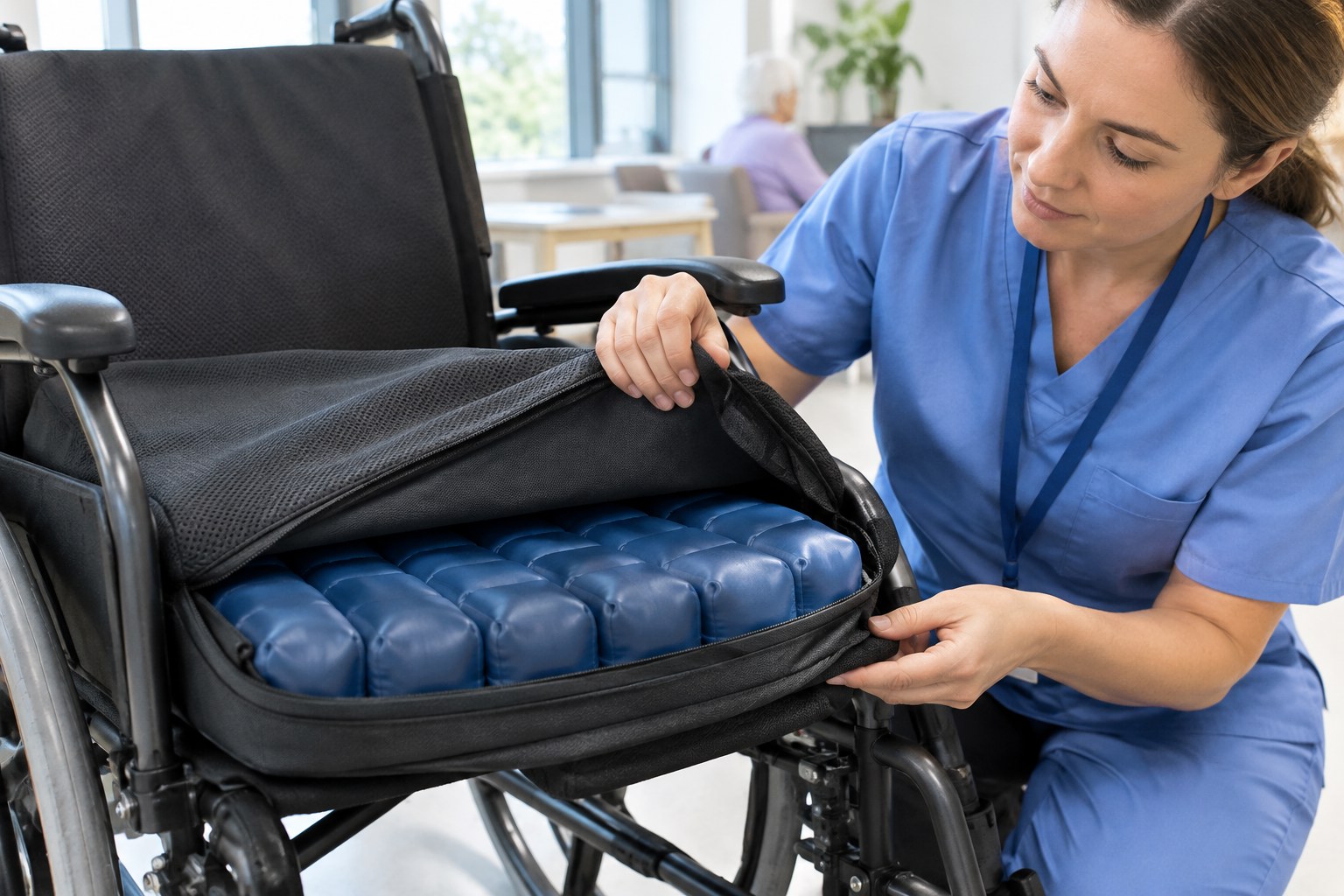
A pressure ulcer prevention cushion, also commonly described as a pressure relief cushion or pressure redistribution cushion, is a seating support designed to help redistribute pressure when a person remains seated for extended periods.
Pressure injuries can develop when tissue is exposed to excessive or prolonged pressure, particularly around bony areas such as the ischial tuberosities, sacrum, and coccyx.
For wheelchair users and residents who spend significant time seated, the seating surface is therefore an important part of pressure injury prevention.
The National Pressure Injury Advisory Panel (NPIAP) recommends the use of a pressure-redistributing chair cushion for individuals sitting in chairs or wheelchairs.
Importantly, a cushion should not be viewed as a stand-alone solution. NPIAP guidance emphasizes that the entire seating system—including the wheelchair configuration, back support, cushion, positioning, and other accessories—can influence pressure management and tissue integrity.
Why Pressure Redistribution Matters in Senior Living
Many older adults in long-term care spend substantial portions of the day sitting.
A resident may move between:
- Bed
- Wheelchair
- Dining chair
- Recliner
- Activity chair
- Transportation chair
When a resident has limited mobility or cannot perform effective weight shifts independently, prolonged sitting can create sustained loading on vulnerable areas.
Current CMS guidance recognizes pressure redistribution cushions as one type of intervention that may be used for residents at risk of pressure injuries. CMS also emphasizes that a specialized cushion does not eliminate the need for periodic repositioning and skin assessment.
For senior living facilities, this means cushion selection should be considered as part of a broader resident-care protocol rather than as an isolated product purchase.
What Should Senior Living Buyers Look for in a Pressure Ulcer Prevention Cushion?
When evaluating products for facility use, purchasing teams should look beyond the basic question of whether a cushion is “soft.”
The following factors are often more important.
1. Pressure Redistribution
The primary consideration is how effectively the cushion redistributes pressure away from vulnerable areas.
Different cushion constructions use different approaches, including:
- Immersion and envelopment
- Off-loading
- Pressure redistribution
- Contoured support
- Air-cell technology
- Gel or foam-based designs
- Hybrid constructions
NPIAP guidance describes pressure redistribution as a key consideration when selecting seating support surfaces.
A good purchasing process should therefore evaluate the cushion’s pressure-management characteristics rather than simply comparing thickness or softness.
2. Resident-Specific Fit
There is no single cushion that is appropriate for every resident.
A resident’s:
- Body weight
- Pelvic position
- Posture
- Sensory status
- Mobility
- Sitting tolerance
- Existing skin condition
- Ability to perform weight shifts
- Wheelchair dimensions
can all affect cushion selection.
Current clinical guidance recommends considering the complete wheelchair seating system, including appropriate fitting and positioning, rather than selecting a cushion independently of the wheelchair.
For facilities, this means a purchasing standard should allow enough flexibility to accommodate different resident profiles.
3. Skin Protection
For residents who have a history of pressure injuries or other risk factors, skin protection becomes particularly important.
A pressure redistribution cushion may help reduce concentrated loading, but it should be combined with:
- Regular skin inspection
- Appropriate repositioning
- Proper wheelchair fit
- Pressure relief techniques
- Moisture management
- Staff education
- Individualized care plans
NPIAP prevention guidance specifically includes pressure-redistributing chair cushions as part of pressure injury prevention for people sitting in chairs or wheelchairs.
4. Postural Stability
Pressure management is not the only consideration.
A cushion that provides appropriate pelvic and postural support may help the resident maintain a more stable sitting position.
This matters because poor positioning can contribute to:
- Sliding
- Pelvic rotation
- Asymmetrical loading
- Shear
- Reduced sitting tolerance
- Difficulty with transfers
The 2023 Wound Healing Society guidelines recommend a wheeled mobility seating assessment and properly fitted wheelchair for people who primarily use wheelchairs, with attention to postural support, weight distribution, pressure reduction, and an appropriate seat cushion.
For institutional buyers, this means the cushion should be evaluated as part of the resident’s seating system—not as a generic accessory.
Foam vs. Gel vs. Air: Which Pressure Relief Cushion Is Better?
One of the most common purchasing questions is whether a facility should choose foam, gel, air, or hybrid cushions.
The answer depends on the resident and the intended application.
Foam Cushions
Foam cushions can provide:
- Stable seating
- Easy handling
- Low maintenance
- Consistent support
- Cost-effective facility deployment
They may be suitable for residents with lower or moderate seating-support requirements, depending on the specific construction and clinical assessment.
Gel Cushions
Gel-based cushions may provide:
- Pressure redistribution
- Immersion
- Comfortable seating
- Stable support
However, buyers should evaluate weight, maintenance, temperature characteristics, durability, and cleaning requirements.
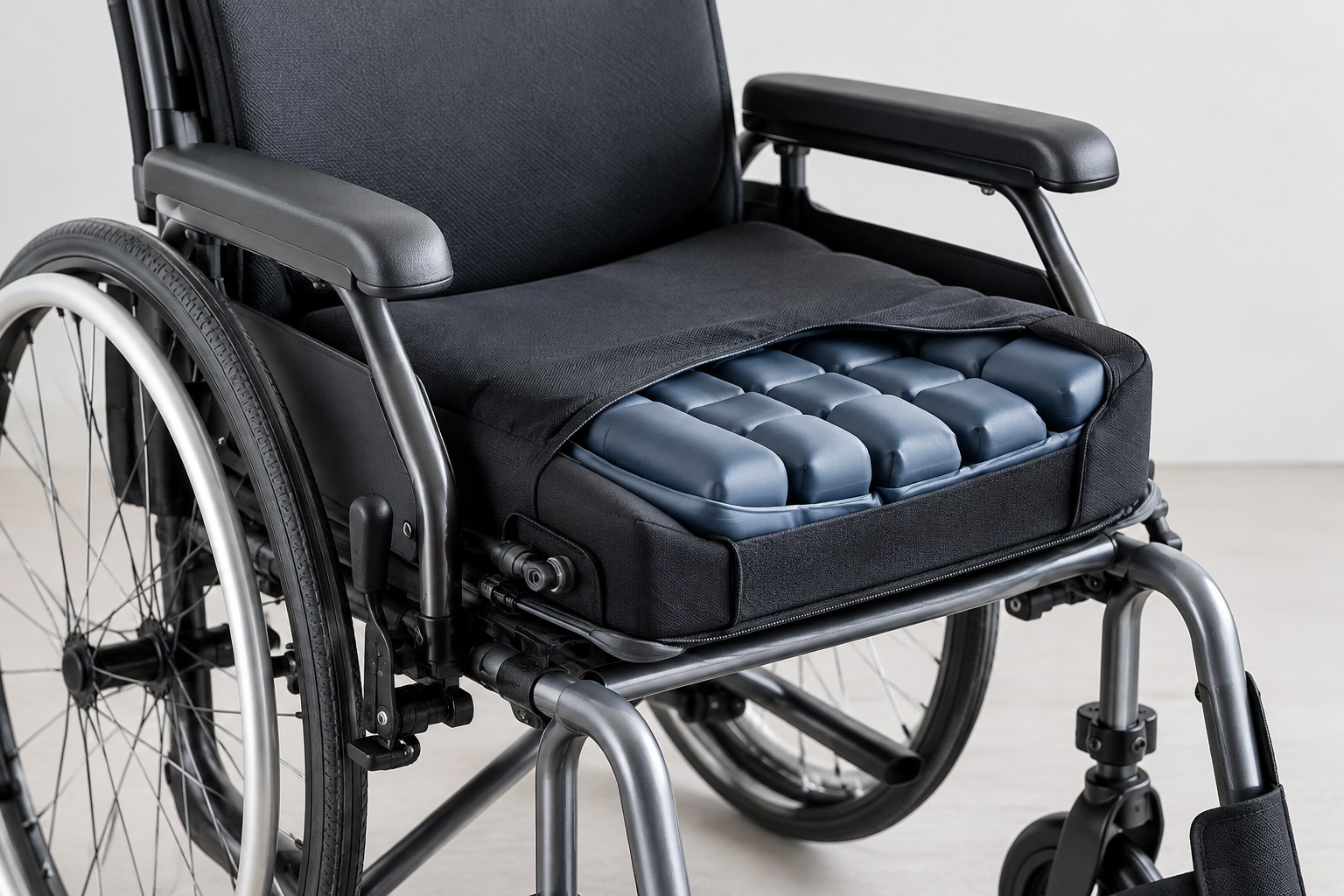
Air Cushions
Air cushions can provide adjustable pressure redistribution and immersion.
They may be considered for residents with higher pressure-management needs, particularly when individualized adjustment is important.
However, facilities should also consider:
- Inflation requirements
- Staff training
- Maintenance
- Leakage risk
- Pressure adjustment
- Cleaning
- User weight
- Wheelchair compatibility
Hybrid Cushions
Hybrid designs combine different materials or technologies to balance:
- Pressure redistribution
- Stability
- Comfort
- Positioning
- Durability
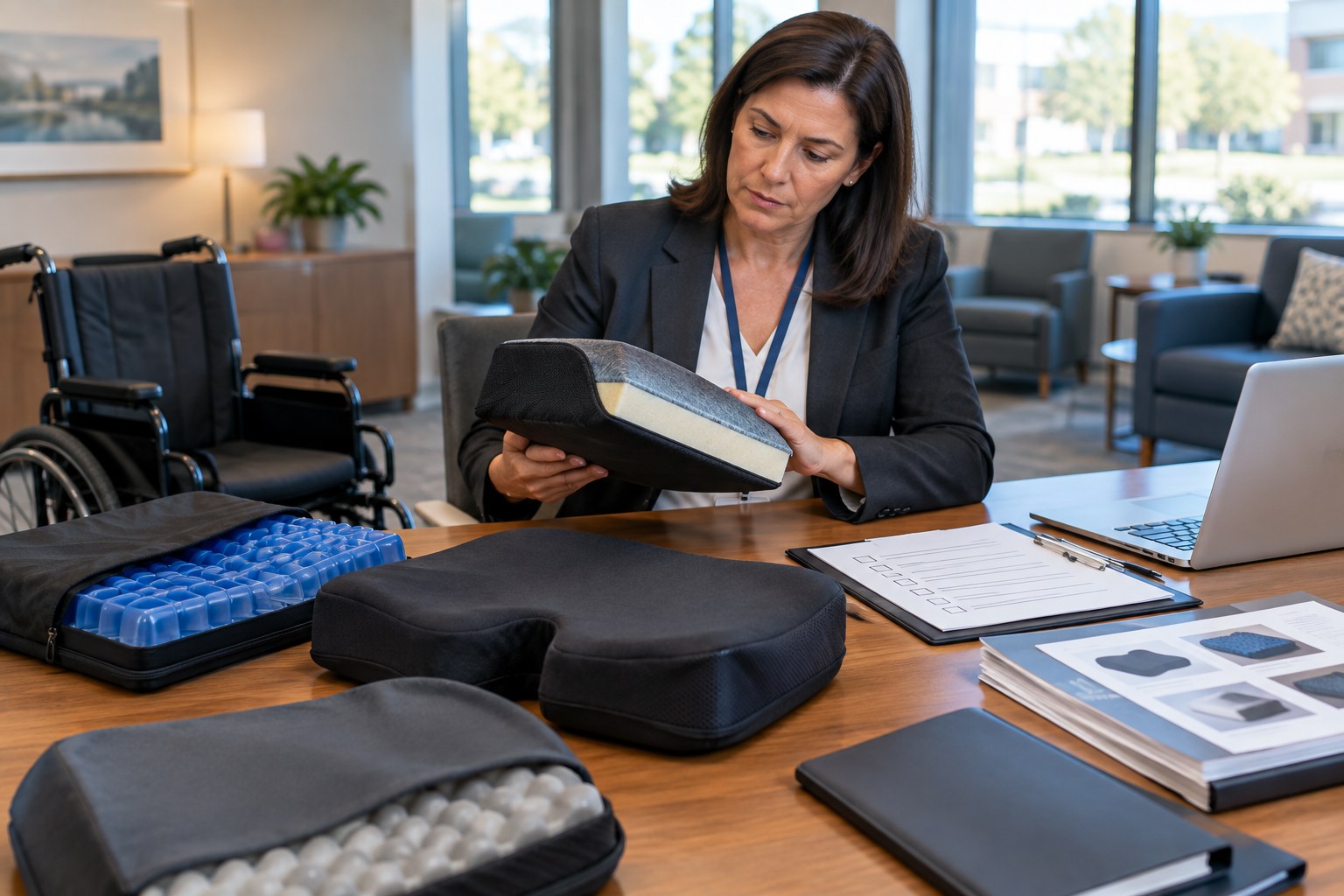
For large senior living communities, a combination of cushion types may be more practical than attempting to standardize every resident on one product.
What Makes a Good Pressure Ulcer Prevention Cushion for a Nursing Home?
For institutional purchasing, product performance is only part of the decision.
A cushion may perform well clinically but still be difficult to manage across dozens or hundreds of residents.
Procurement teams should therefore evaluate five areas:
Clinical suitability
Can the cushion support the pressure-management requirements of the intended resident population?
Durability
Can it withstand repeated daily use, transfers, cleaning, and repositioning?
Hygiene
Does the cover have a removable and washable design?
Can replacement covers be supplied?
Are the materials appropriate for repeated institutional cleaning?
Compatibility
Does the cushion fit the facility’s wheelchair fleet?
Are standard dimensions available?
Can different sizes be supplied consistently?
Supply capability
Can the supplier support:
- Bulk orders
- Repeat orders
- Multiple sizes
- Replacement covers
- OEM/private-label requirements
- Packaging customization
- Stable production
- International shipping
For a senior living organization, these factors can be just as important as the initial unit price.
Pressure Ulcer Prevention Cushion Should Not Replace Repositioning
This is one of the most important points for caregivers and purchasing teams.
A pressure redistribution cushion does not mean that a resident can remain in the same position indefinitely.
CMS guidance states that a specialized pressure redistribution cushion may help extend sitting time for some residents, but it does not eliminate the need for periodic repositioning and skin assessment.
NPIAP prevention guidance likewise recommends repositioning individuals who are weak or immobile while seated.
Therefore, the most effective facility-level approach combines:
Appropriate cushion + correct seating configuration + repositioning + skin assessment + caregiver education
rather than relying on a cushion alone.
Pressure Ulcer Prevention Cushion Purchasing Checklist
Before approving a new supplier, senior living procurement teams can ask:
Product
- What cushion technologies are available?
- What pressure redistribution method is used?
- What resident profiles is the cushion designed for?
- What sizes are available?
- What weight capacities are available?
- Is the cushion suitable for manual and/or power wheelchairs?
Hygiene
- Is the cover removable?
- Is it washable?
- Is a replacement cover available?
- What cleaning instructions are provided?
Durability
- What is the expected service life?
- How does the cushion perform under daily institutional use?
- Are replacement components available?
Seating
- Does the cushion fit the facility’s wheelchair fleet?
- Are standard dimensions available?
- Does the design provide appropriate postural stability?
Supplier
- Can the supplier support bulk purchasing?
- Can samples be provided?
- Can the supplier provide product specifications?
- Is OEM or private-label production available?
- What is the minimum order quantity?
- What is the production lead time?
- Can repeat orders be maintained consistently?
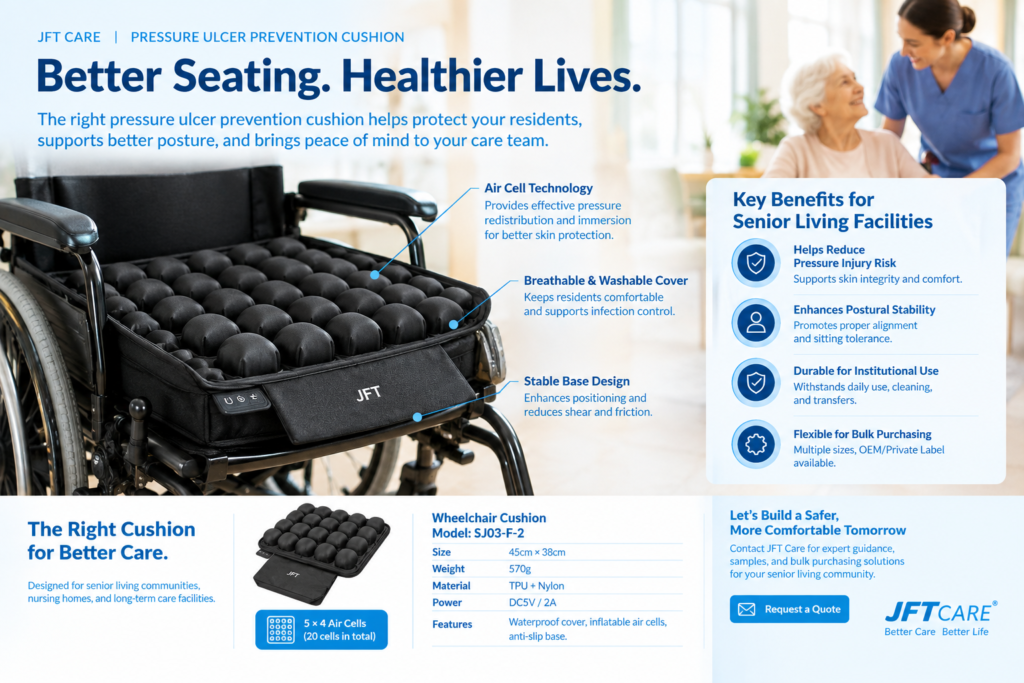
What Should Distributors Look for in a Pressure Relief Cushion Supplier?
For medical equipment distributors and senior care product distributors, the evaluation criteria are slightly different.
A distributor needs a product that is not only useful to the end user but also commercially practical.
Look for a supplier that can provide:
Consistent quality
The product should maintain consistent specifications between production batches.
Stable supply
A product that sells well but cannot be replenished reliably creates problems for distributors and facility customers.
Multiple sizes and configurations
Different users require different seating dimensions and support characteristics.
OEM / Private Label Support
For established distributors, private-label production can create opportunities to build a dedicated senior-care product line.
Professional documentation
Product specifications, cleaning instructions, packaging information, and user documentation make the product easier to introduce into institutional purchasing systems.
Bulk-order capability
A senior living community may purchase multiple units at once and then require ongoing replacement orders.
The supplier should therefore be prepared for both initial purchasing and long-term replenishment.
Why Facility-Wide Standardization Can Matter
A senior living community may have dozens or hundreds of wheelchairs.
If every cushion is purchased independently, the facility can quickly end up with multiple:
- Sizes
- Materials
- Covers
- Cleaning procedures
- Replacement schedules
- Supplier contacts
This can increase staff workload.
A more structured procurement strategy can identify a small number of approved cushion configurations for different resident needs.
For example:
Standard seating cushion
For residents with basic comfort and support requirements.
Pressure redistribution cushion
For residents with elevated pressure injury risk.
Advanced skin-protection cushion
For residents requiring more specialized seating support.
This approach does not mean every resident receives the same cushion. Instead, it creates a standardized purchasing framework while preserving individualized clinical selection.
Questions to Ask Before Choosing a Pressure Ulcer Prevention Cushion Supplier
If you are a senior living purchasing manager, distributor, DME provider, or healthcare equipment buyer, ask your supplier:
Can you provide samples for evaluation?
What cushion sizes can you manufacture?
What is the pressure redistribution technology?
Can you provide detailed product specifications?
Do you support bulk orders for senior living communities?
Can you provide replacement covers or components?
Do you offer OEM or private-label production?
What is your MOQ?
What is your production lead time?
Can you maintain consistent specifications for repeat orders?
These questions can help move the conversation from “How much is one cushion?” to “Can this supplier support our long-term facility requirements?”
Choosing a Pressure Ulcer Prevention Cushion Is a System Decision
For senior living facilities, pressure injury prevention is rarely solved by one product.
A cushion is one component of a broader seating and care system.
The purchasing decision should consider:
Resident risk
↓
Seating assessment
↓
Pressure redistribution
↓
Postural support
↓
Repositioning
↓
Skin assessment
↓
Caregiver implementation
↓
Ongoing evaluation
The right cushion should support this system, not replace it.
Looking for a Pressure Ulcer Prevention Cushion Supplier?
JFT Care develops and manufactures seating and pressure-relief solutions for healthcare, senior care, rehabilitation, and long-term care applications.
For senior living communities, distributors, and healthcare equipment companies, we can discuss:
- Pressure relief cushion solutions
- Wheelchair seating products
- Bulk purchasing
- OEM / private label
- Custom sizes and specifications
- Facility-level product requirements
- Sample evaluation
- Long-term supply programs
If you are evaluating a pressure ulcer prevention cushion for a senior living community or distribution program, send us your required size, resident application, estimated quantity, and target market.
Our team can help you evaluate the appropriate product configuration and prepare a quotation for your project.
Medical & Safety Disclaimer
Select and use a pressure ulcer prevention cushion based on the individual resident’s clinical condition, seating needs, and care plan. A cushion does not eliminate the need for repositioning, skin assessment, appropriate wheelchair fitting, or professional clinical evaluation. Healthcare facilities should follow applicable clinical guidelines and the recommendations of qualified healthcare professionals.


Leave a Reply