
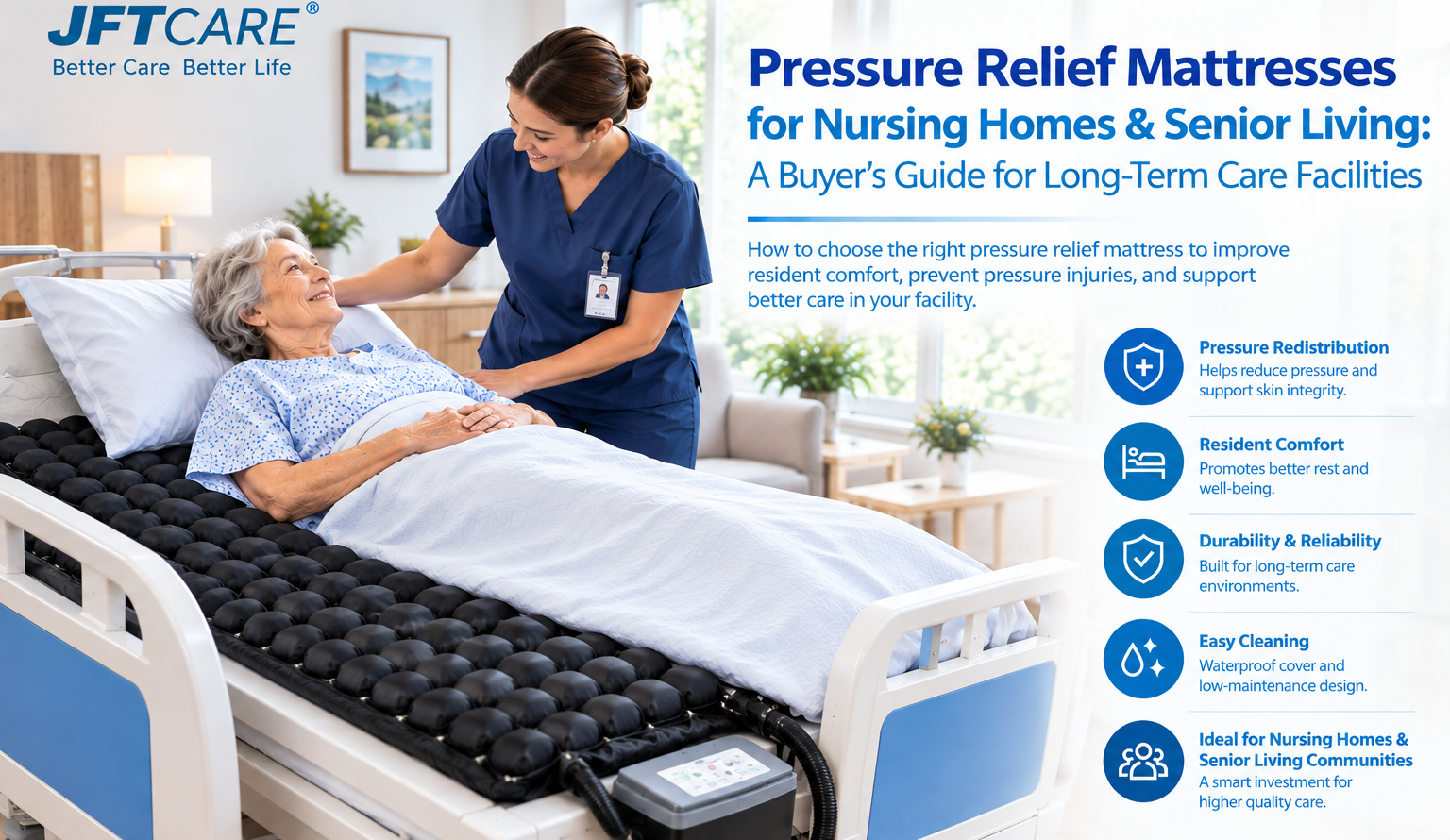
For nursing homes, skilled nursing facilities, and senior living communities, choosing the right pressure relief mattress is about more than comfort or price.
Residents who spend extended periods in bed may have limited mobility and other factors that increase the need for effective pressure redistribution. For facility teams, the right support surface also needs to fit clinical protocols, caregiver workflows, cleaning requirements, durability expectations, and the realities of long-term care operations.
That makes mattress selection an important purchasing decision—not simply a furniture decision.
A pressure relief mattress for nursing homes should be evaluated as part of a broader pressure injury prevention and resident-care strategy. The appropriate surface depends on the resident’s individual risk factors, mobility, care plan, and clinical assessment. CMS guidance for pressure-reducing support surfaces, for example, considers factors such as immobility, limited mobility, existing pressure ulcers, nutrition, incontinence, sensory perception, and circulation.
This guide explains what nursing home and senior living buyers should consider when evaluating pressure-relief mattresses and alternating-pressure air mattress systems for long-term care environments.
What Is a Pressure Relief Mattress?
A pressure relief mattress is a support surface designed to help redistribute pressure across the body rather than allowing prolonged pressure to remain concentrated over vulnerable areas.
Depending on the design, pressure-relieving mattresses may include:
- High-specification foam
- Static air systems
- Alternating pressure air systems
- Hybrid support surfaces
- Low-air-loss systems
- Other specialized pressure redistribution technologies
The appropriate mattress depends on the resident’s needs and the facility’s care protocols.
For example, CMS’s current guidance for Group 1 pressure-reducing support surfaces includes residents who are completely immobile, residents with limited mobility and specified risk factors, and residents with pressure ulcers under defined circumstances. CMS also emphasizes that the support surface should be appropriate for the individual and should not allow excessive “bottoming out.”
For facility buyers, this leads to an important principle:
The most expensive mattress is not automatically the most appropriate mattress.
The better purchasing decision is the one that matches the resident population, clinical requirements, staff workflow, maintenance expectations, and facility budget.
Why Pressure Relief Mattresses Matter in Nursing Homes
Nursing homes and skilled nursing facilities care for residents with widely different levels of mobility and clinical needs.
Some residents may be able to reposition independently. Others may require significant assistance with repositioning or spend much of their time in bed.
This distinction matters.
CMS guidance specifically recognizes complete immobility and limited mobility as factors relevant to pressure-reducing support surface coverage.
For nursing home procurement teams, mattress selection should therefore be considered alongside:
- Resident mobility
- Pressure injury risk assessment
- Repositioning protocols
- Skin inspection
- Moisture and incontinence management
- Nutrition
- Existing pressure injuries
- Caregiver workload
- Mattress maintenance
- Cleaning and infection-control procedures
A mattress is one component of a broader care plan, not a replacement for clinical assessment, repositioning, skin care, nutrition management, or wound care.
This distinction is especially important when evaluating supplier claims.
A professional healthcare supplier should explain what its mattress is designed to do without presenting the product as a standalone solution for preventing or treating every pressure injury.
Pressure Relief Mattress vs. Alternating Pressure Mattress
One of the most common questions from long-term care buyers is:
What is the difference between a pressure relief mattress and an alternating pressure mattress?
The terms overlap, but they are not necessarily interchangeable.
Pressure relief mattress
“Pressure relief mattress” is a broad purchasing term that can refer to different types of support surfaces designed to redistribute pressure.
Alternating pressure mattress
An alternating pressure mattress generally uses an air-cell system that changes inflation/deflation patterns over time.
The goal is to vary pressure distribution rather than maintaining the exact same pressure pattern continuously.
Healthcare quality measures and clinical guidance have specifically recognized alternating pressure air mattresses or overlays as an option to assess for individuals at risk of pressure injuries.
For a nursing home buyer, the more useful question is therefore not:
“Which mattress is the best?”
but:
“Which support surface is appropriate for this resident population and our care protocols?”
7 Factors to Consider When Buying a Pressure Relief Mattress for Nursing Homes
Choosing a mattress for a single resident is different from purchasing dozens or hundreds of units for a nursing home network.
Facility procurement teams should evaluate both resident-level performance and facility-level practicality.
1. Pressure Redistribution Performance
The first consideration should be how the mattress is designed to redistribute pressure.
Ask suppliers:
- What type of support surface is this?
- How is pressure distributed?
- Is the system static or dynamic?
- Can pressure settings be adjusted?
- Is the system designed for residents with limited mobility?
- How should the mattress be used within the facility’s care protocols?
Avoid evaluating products based solely on marketing terms such as “anti-bedsore” or “massage.”
For professional U.S. healthcare buyers, terms such as pressure redistribution, pressure injury prevention, pressure relief, and support surface provide more useful context.
2. Resident Weight Capacity
Weight capacity is one of the most important technical specifications when evaluating a mattress.
A supplier should clearly provide:
- Recommended user weight range
- Maximum user weight
- Mattress dimensions
- Compatibility with the facility’s bed frame
- Recommended operating conditions
The support surface must be appropriate for the resident and should not permit excessive bottoming out.
CMS guidance for pressure-reducing support surfaces specifically addresses the need for the support surface to prevent “bottoming out.”
For procurement teams, this information should be documented before placing a facility-wide order.
3. Pump Performance and Ease of Operation
For an alternating pressure air mattress, the pump is just as important as the mattress itself.
Procurement teams should evaluate:
- Pressure adjustment
- Inflation time
- Operating noise
- Power requirements
- Alarm functions, if applicable
- Ease of installation
- Ease of operation
- Reliability
- Replacement availability
A technically impressive mattress can become a poor facility solution if staff find the pump difficult to configure or maintain.
For a multi-room nursing facility, operational simplicity matters.
A nurse or caregiver should not need an unnecessarily complicated process every time a mattress is installed, adjusted, cleaned, or transferred.
4 Waterproof and Easy-to-Clean Materials
Long-term care environments place significant demands on mattress covers.
A mattress may encounter:
- Moisture
- Incontinence
- Body fluids
- Food and drink
- Frequent cleaning
- Repeated transfers
- Daily caregiver handling
For this reason, buyers should ask:
Is the cover waterproof?
Is it removable?
How should it be cleaned?
What cleaning agents are compatible with the material?
How frequently can the cover be cleaned?
Are replacement covers available?
These questions can be just as important as the initial purchase price.
5. Durability and Total Cost of Ownership
For a senior living community or nursing home network, the cheapest unit price does not necessarily mean the lowest total cost.
Consider:
Expected service life
Pump replacement
Mattress repair
Replacement covers
Maintenance labor
Downtime
Shipping
Training
Total Cost of Ownership
A supplier that provides clear replacement parts, technical support, and maintenance information may offer more practical value than a supplier that simply offers the lowest initial quotation.
This is particularly important when purchasing dozens or hundreds of mattresses.
6. Staff Workflow and Resident Comfort
Healthcare equipment should work for both residents and caregivers.
A mattress that provides pressure redistribution but creates unnecessary operational problems may not be the best facility-wide solution.
Consider:
- Is installation straightforward?
- Can caregivers understand the controls quickly?
- Is the pump reasonably quiet?
- Is the mattress comfortable for extended use?
- Is transferring the resident practical?
- Can staff easily inspect the mattress?
- Is the cover easy to clean?
For premium senior living communities, resident experience is also an important consideration.
A support surface should not be evaluated only as a medical product. It is part of the resident’s daily living environment.
7. Supplier Support and Purchasing Capability
This is where many facility buyers underestimate the importance of the manufacturer.
Suppose a nursing home purchases 20 mattresses.
That is one type of purchasing relationship.
Now consider:
100 mattresses
500 mattresses
or a multi-location senior living group.
At that point, the supplier’s manufacturing and support capabilities become much more important.
Before selecting a supplier, ask:
- Can you support bulk orders?
- What is your standard production lead time?
- Can you provide replacement parts?
- Can you provide replacement covers?
- What is your warranty policy?
- Can you provide proOEM Aircell Seat Cushions Manufacturer | JFT Care Elderly Pressure Relief Cushion Supplierduct documentation?
- Can you support OEM/private-label requirements?
- Can packaging be customized?
- Can the supplier maintain consistent product specifications for repeat orders?
For B2B healthcare procurement, the supplier’s ability to support the product after the purchase order is often just as important as the product itself.
Nursing Home vs. Senior Living: What Should Buyers Consider?
Although the terms are sometimes used broadly, nursing homes and senior living communities can have different purchasing priorities.
Nursing Homes and Skilled Nursing Facilities
Nursing homes and skilled nursing facilities generally serve residents with a wider range of healthcare and nursing needs.
For these buyers, important considerations may include:
- Pressure injury risk management
- Pressure redistribution
- Resident mobility
- Clinical protocols
- Caregiver workflow
- Cleaning and maintenance
- Durability
- Documentation
- Facility-wide standardization
For this market, a pressure relief mattress for nursing homes should be positioned around pressure redistribution, operational practicality, and long-term facility use.
Senior Living Communities
Senior living is broader and can include communities serving residents with different levels of independence and care needs.
Depending on the community, purchasing priorities may place greater emphasis on:
- Resident comfort
- Quality of life
- Appearance
- Quiet operation
- Ease of use
- Durability
- Cleaning
- Resident safety
- Care needs as residents age
This means a single mattress specification may not be appropriate for every resident or every senior living environment.
A good procurement process should match the support surface to the resident population and care setting.
What Should a Nursing Home Ask a Mattress Supplier?
Before sending an RFQ, procurement teams can use the following checklist.
Product Specifications
- What is the mattress size?
- What is the maximum user weight?
- What materials are used?
- What type of pressure redistribution technology is used?
- Is the system static or alternating?
- What are the pump specifications?
- What is the expected service life?
Cleaning & Maintenance
- Is the cover waterproof?
- Is the cover removable?
- How should it be cleaned?
- Are replacement covers available?
- Are replacement pumps available?
- Are replacement air cells available?
Facility Operations
- Is the system easy for caregivers to install?
- Is the pump quiet?
- Is staff training required?
- Can the product be standardized across multiple rooms?
Supplier Capability
- What is the MOQ?
- What is the lead time?
- Can you support repeat orders?
- Do you support bulk purchasing?
- Do you offer OEM?
- Do you offer private labeling?
- Can packaging be customized?
- What after-sales support is available?
When Should a Facility Consider an Alternating Pressure Air Mattress?
An alternating pressure air mattress may be considered when a resident’s mobility, pressure injury risk, or care requirements indicate that a dynamic pressure redistribution surface may be appropriate.
However, product selection should be based on an individual assessment and the facility’s clinical protocols.
CMS coverage guidance illustrates why this matters: support-surface selection can be connected with documented mobility limitations, pressure ulcers, nutrition, incontinence, sensory perception, circulation, repositioning, wound care, and other aspects of a broader care plan.
Therefore, a responsible supplier should avoid suggesting that one mattress is universally appropriate for every resident.
Instead, the supplier should help the buyer understand:
What the product is designed for, who it may be suitable for, how it should be configured, and what facility requirements it supports.
To be continue




Leave a Reply