

A Practical Guide to Pressure Relief Cushions for Nursing Homes & Senior Living Communities
Is long-term wheelchair seating becoming a daily challenge for your care team?
Maybe a resident spends several hours in a wheelchair but gradually slides forward.
Maybe caregivers repeatedly reposition the resident.
Maybe the resident cannot perform an effective weight shift independently.
Maybe staff are concerned about pressure around the buttocks, ischial area, sacrum, or thighs.
Or perhaps the bigger problem is that your facility has several different wheelchair cushions, but no consistent way to determine which seating surface is appropriate for each resident.
For nursing homes and senior living communities, long-term wheelchair seating is not simply a comfort issue.
It involves positioning, pressure redistribution, stability, resident tolerance, caregiver workflow, and individualized assessment.
The 2026 International Guideline recommends pressure-redistribution seating surfaces for people who are seated and at risk of pressure injuries, and emphasizes matching cushion selection to the individual’s dimensions, functional needs, posture, stability, sensation, and comfort.
So the question for a facility is not simply:
“Which wheelchair cushion should we buy?”
A better question is:
“What is making long-term wheelchair seating difficult for our residents and caregivers—and what type of pressure redistribution support fits that problem?”
1. Why Is Long-Term Wheelchair Seating So Difficult?
For a healthy person, sitting in one position for a long time may simply become uncomfortable.
For an older adult with limited mobility, reduced sensation, cognitive impairment, postural instability, or an inability to perform effective weight shifts, the situation can be very different.
When sitting, body weight is supported by a relatively small contact area. The International Guideline notes that this can create higher interface pressures, particularly around areas such as the ischial tuberosities and sacrum when sitting is prolonged. International Guideline
This creates several practical challenges for long-term care facilities:
- Maintaining pelvic positioning
- Managing pressure concentration
- Reducing shear and friction
- Supporting postural stability
- Maintaining resident comfort
- Allowing appropriate repositioning
- Cleaning and maintaining the cushion
- Training caregivers
- Standardizing equipment across multiple residents
And every resident is different.
That’s why a one-cushion-fits-all approach can be difficult to implement in a professional care environment.
2. What Is Your Facility’s Biggest Wheelchair Seating Challenge?
Before purchasing new equipment, ask your care team these five questions.
Question 1: Can the resident reposition independently?
If the resident cannot perform an effective pressure-relieving maneuver, the seating surface becomes particularly important.
CMS identifies impaired sensation or inability to perform a functional weight shift among the clinical circumstances relevant to certain wheelchair seating coverage criteria.
Question 2: Does the resident maintain a stable sitting position?
Watch for:
- Sliding forward
- Pelvic rotation
- Leaning to one side
- Slouching
- Excessive posterior pelvic tilt
- Feet not properly supported
- Frequent need for caregiver repositioning
The cushion is only one part of the seating system, but its interaction with the wheelchair and resident can affect stability and positioning.
Question 3: How long does the resident remain seated?
A resident who sits for 30 minutes is different from someone who spends several hours in a wheelchair every day.
The 2026 International Guideline specifically recommends considering the duration of sitting, support surface, positioning, and repositioning strategy together.
Question 4: Does the current cushion provide pressure redistribution?
Don’t judge a cushion only by how soft it feels.
A pressure redistribution cushion is designed to change how load is distributed across the contact surface.
The International Guideline describes pressure redistribution through mechanisms such as immersion/envelopment and off-loading. International Guideline
Question 5: Is the cushion practical for caregivers?
Even a technically sophisticated cushion can become a problem if staff struggle with:
- Correct positioning
- Inflation
- Cleaning
- Cover removal
- Maintenance
- Daily inspection
- Adjustment
- Replacement
For B2B healthcare buyers, clinical considerations and operational considerations need to be evaluated together.
3. Why Pressure Redistribution Matters in Wheelchair Seating
A common mistake is to think:
Soft = pressure relief.
It’s not that simple.
The objective of a pressure redistribution cushion is to help distribute loading over an appropriate contact area rather than allowing excessive concentration in vulnerable locations.
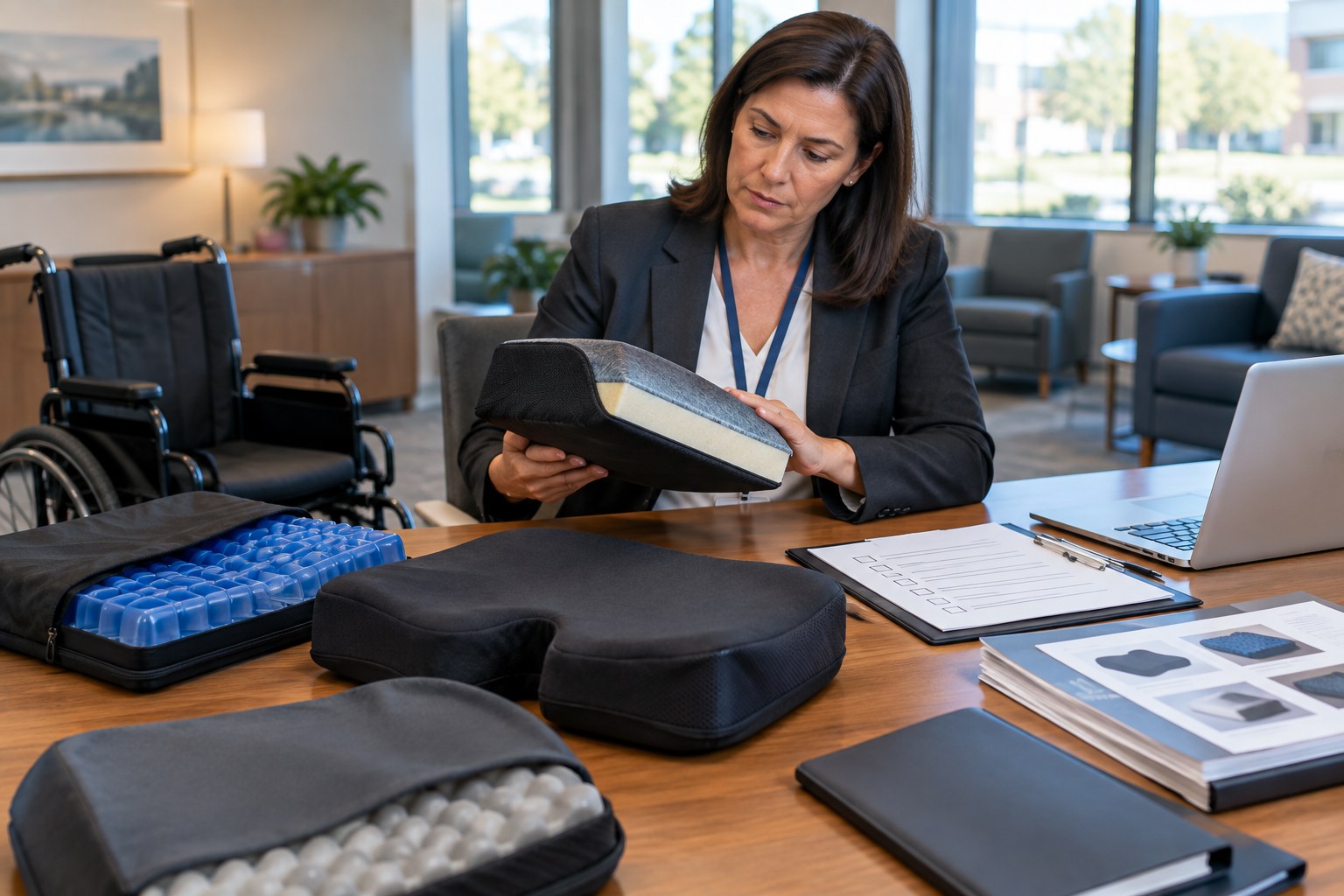
Different cushion technologies achieve this in different ways.
Foam
Foam cushions can provide support and contouring and may be appropriate for some residents.
Gel
Gel-based cushions can provide immersion and pressure redistribution characteristics depending on the design.
Air
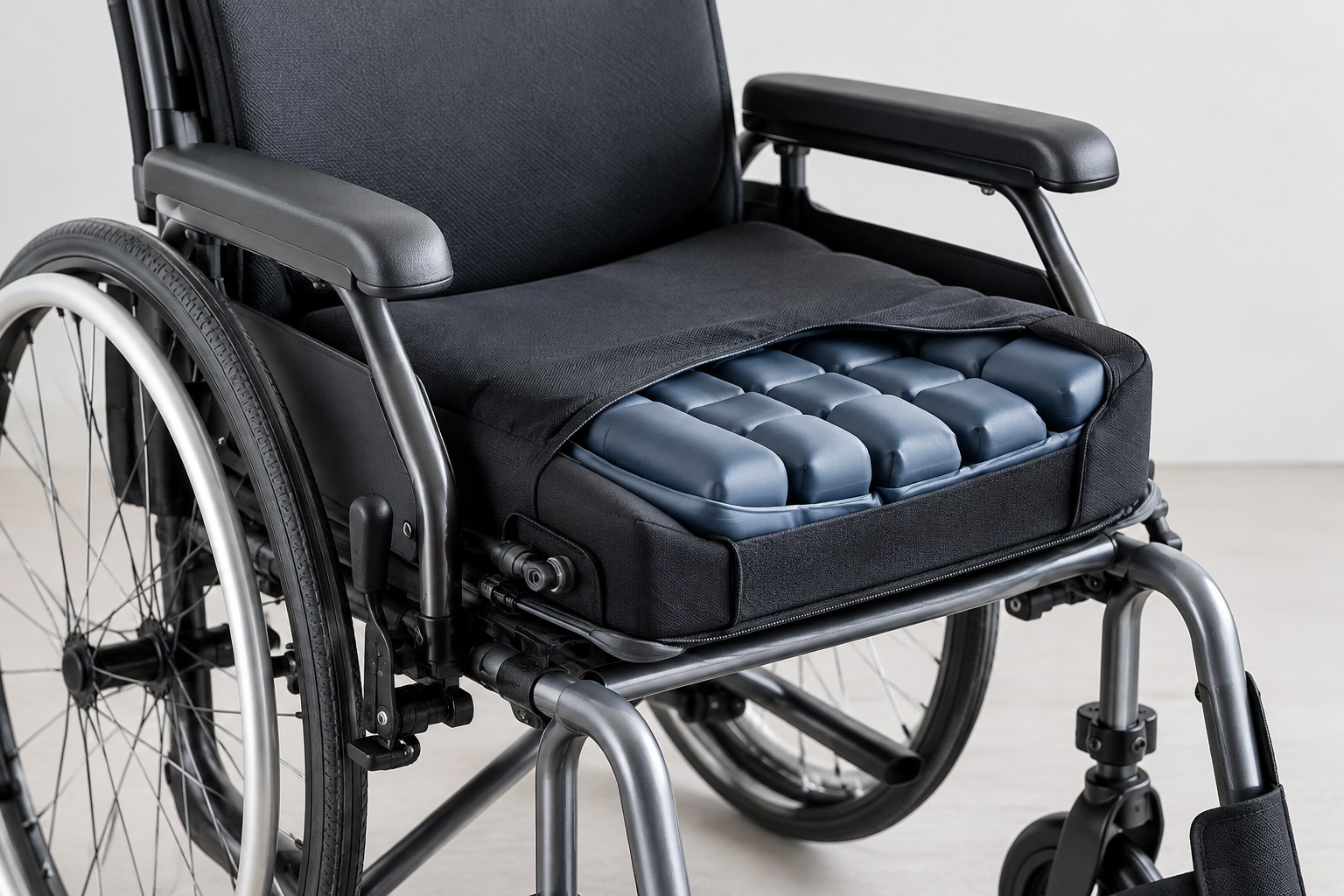
Air-cell cushions can provide pressure redistribution through adjustable air support and cell-based construction.
Hybrid
Hybrid cushions combine different materials or technologies to achieve specific support characteristics.
The appropriate choice depends on the individual resident and seating system—not simply the material name.
The current International Guideline recommends selecting pressure redistribution cushions based on individual dimensions, functional requirements, posture, stability, sensation, comfort, and appropriate weight limitations.
4. What Should Nursing Homes Look for in Pressure Relief Cushions?
If your facility is evaluating pressure relief cushions for nursing homes, consider these seven factors.
1. Pressure Redistribution
Start with the most important question:
How does the cushion redistribute pressure?
Ask suppliers to explain the technology rather than simply describing the cushion as “soft” or “comfortable.”
2. Resident Weight Capacity
A cushion must be appropriate for the resident’s weight according to the manufacturer’s specifications.
For a facility purchasing multiple units, procurement teams should create clear requirements covering the expected resident weight range.
3. Stability
Pressure redistribution should not be considered independently from stability.
The International Guideline specifically notes the need to weigh the benefits of off-loading or immersion against potential instability and shear. International Guideline
A cushion should therefore be evaluated in the actual wheelchair and with the intended resident whenever appropriate.
4. Heat and Moisture Management
Long-term seating can create additional challenges related to heat and moisture.
When comparing cushions, ask about:
- Cover materials
- Breathability
- Heat dissipation
- Moisture management
- Cleaning requirements
The International Guideline specifically recommends considering heat dissipation properties of the cushion and cover.
5. Cover and Cleaning
This is extremely important in a nursing home environment.
A procurement team should ask:
- Is the cover removable?
- Is it washable?
- Is it wipe-clean?
- Is the material waterproof or water-resistant?
- How should it be disinfected?
- Are replacement covers available?
A cushion that is difficult to maintain may create unnecessary workload for staff.
6. Durability
Don’t only compare the initial purchase price.
Calculate the potential total cost of ownership.
Consider:
Purchase price + replacement covers + repairs + replacement parts + expected service life + staff workload
For a facility purchasing dozens or hundreds of cushions, small differences can become significant.
7. Supplier Support
A good B2B supplier should be able to answer:
- What is the MOQ?
- What is the lead time?
- What is the warranty?
- Are spare parts available?
- Can replacement covers be supplied?
- Can the supplier support repeat orders?
- Is OEM available?
- Is private labeling available?
- Can the supplier provide product documentation?
This becomes particularly important when the facility is standardizing equipment across multiple locations.
5. Pressure Relief Cushion vs. Standard Wheelchair Cushion
The terms are sometimes used interchangeably in casual conversations, but they shouldn’t automatically be treated as the same thing.
A standard wheelchair cushion may primarily focus on:
Comfort + basic support
A pressure redistribution cushion may additionally be designed around:
Pressure redistribution + immersion/envelopment + off-loading + support
For residents at risk of pressure injuries, the International Guideline recommends using a seating support surface with pressure redistribution properties. International Guideline
The important point is that the cushion still needs to be properly selected, fitted, maintained, and used according to the manufacturer’s instructions.
6. What About Air Pressure Relief Cushions?
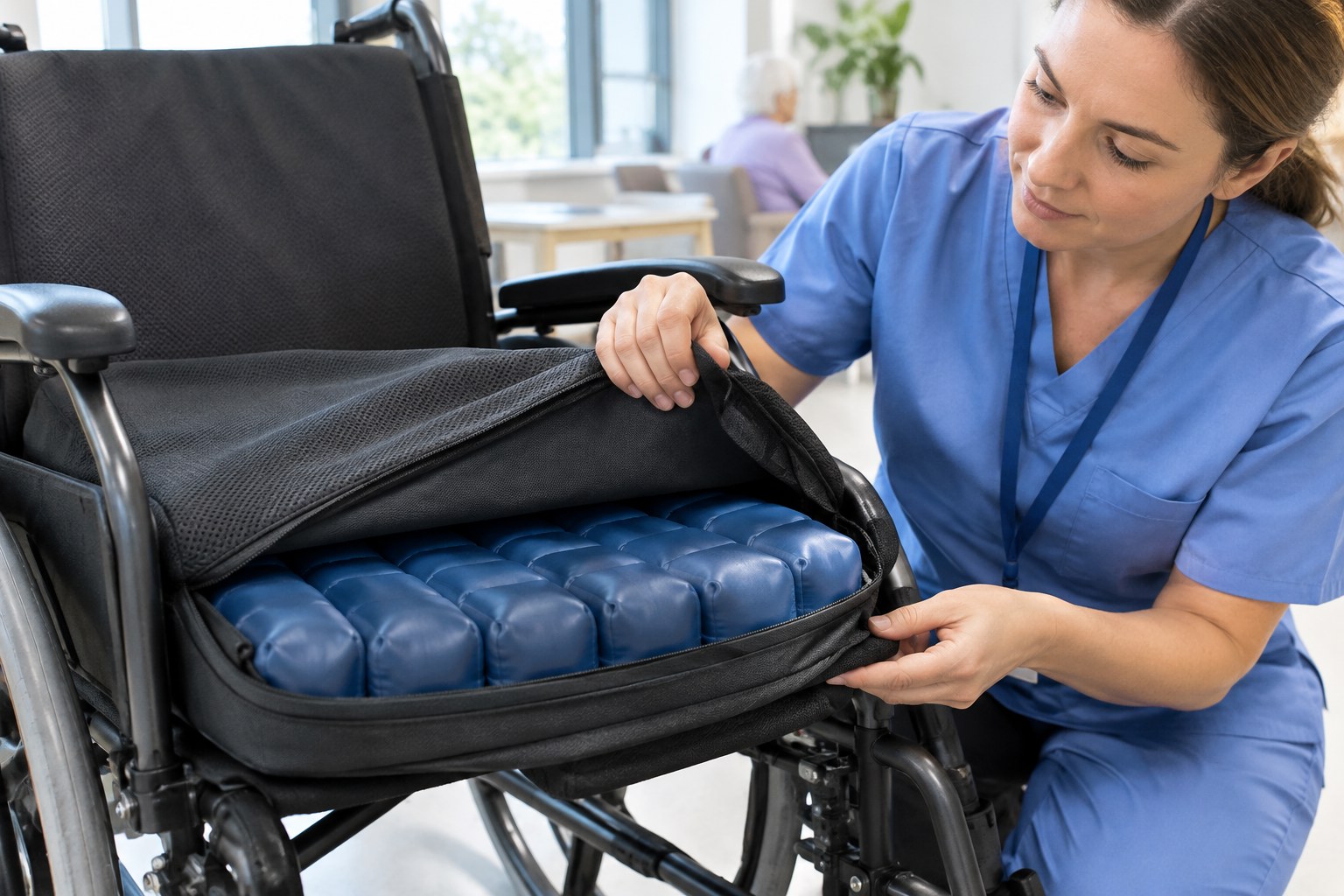
Air-based cushions can be particularly interesting for facilities managing residents who spend extended periods in wheelchairs.
Depending on the design, air-cell systems may allow the support surface to adapt to the resident’s body and distribute loading across multiple cells.
However, air cushions are not automatically appropriate for every resident.
The International Guideline specifically advises evaluating stability, shear, proper inflation, maintenance, and manufacturer recommendations when using pressure redistribution cushions. International Guideline
For facility procurement teams, this means asking more specific questions:
What type of air-cell structure is used?
What is the recommended weight range?
How is inflation adjusted?
How is proper inflation maintained?
What happens if an air cell loses pressure?
How often should the cushion be inspected?
How is the cover cleaned?
These questions are much more useful than simply asking:
“How much is the cushion?”
7. The Caregiver Workflow Matters More Than You Think
Imagine two cushions.
Cushion A
Lower purchase price.
But staff need to:
- Adjust it frequently
- Check it manually
- Learn complicated settings
- Replace components frequently
- Spend extra time cleaning it
Cushion B
Slightly different upfront cost.
But it has:
- Simple adjustment
- Easy-to-clean cover
- Straightforward maintenance
- Clear instructions
- Available replacement parts
- Consistent supply
For an institutional buyer, the comparison should not stop at the unit price.
The better procurement question is:
“Which solution fits our resident population and creates a sustainable workflow for our care team?”
8. Don’t Forget the Wheelchair Itself
One of the biggest mistakes is evaluating a cushion separately from the wheelchair.
The International Guideline emphasizes that seating should be appropriate to the individual’s dimensions, range of movement, functional needs, and postural support requirements. International Guideline
Consider:
- Seat width
- Seat depth
- Back support
- Foot positioning
- Pelvic positioning
- Arm support
- Tilt
- Recline
- Cushion thickness
- Cushion stability
A cushion that performs well in one wheelchair may not perform identically in another setup.
This is why complex seating needs may require assessment by a qualified seating professional such as a physical therapist, occupational therapist, physiotherapist, or seating specialist.
9. What Does This Mean for Senior Living Communities?
Senior Living communities are not identical to skilled nursing facilities.
Some residents may be relatively independent.
Others may require substantial assistance with mobility and positioning.
That means a Senior Living community may need several different levels of seating support.
For example:
Independent Resident
Primary concerns:
- Comfort
- Mobility
- Daily activities
Resident With Limited Mobility
Additional concerns:
- Positioning
- Weight shifting
- Sitting tolerance
- Pressure redistribution
Resident With Significant Mobility Limitations
Potentially greater concern around:
- Prolonged sitting
- Limited repositioning
- Reduced sensation
- Pressure injury risk
- Caregiver assistance
The right procurement strategy should therefore be based on resident profiles, rather than simply ordering one cushion for every wheelchair.
10. When Should a Facility Re-Evaluate Its Wheelchair Cushions?
Don’t wait until a resident complains.
A seating system may need reassessment when:
- The resident’s weight changes
- Body dimensions change
- Mobility changes
- Posture changes
- Sensation changes
- The resident begins sliding
- Caregivers report difficulty repositioning
- The cushion becomes damaged
- The cushion no longer maintains its original characteristics
- The resident’s sitting tolerance changes
The International Guideline recommends reassessment for long-term wheelchair users when body dimensions, range of movement, posture, or physical abilities change. International Guideline
This creates an opportunity for nursing homes to establish a scheduled seating equipment review process rather than treating cushion purchasing as a one-time event.
11. What Are the Biggest Procurement Mistakes?
Here are five common mistakes B2B buyers should avoid.
Mistake #1: Choosing Based Only on Price
A $50 difference in purchase price can become insignificant if the cheaper cushion has a shorter service life or creates additional staff workload.
Mistake #2: Choosing Based Only on Softness
Soft does not automatically mean pressure redistribution.
Ask the supplier how the product is designed to redistribute pressure.
Mistake #3: Buying One Model for Everyone
Residents have different:
- Body dimensions
- Weight
- Mobility
- Sensation
- Posture
- Sitting tolerance
- Support requirements
A standardized procurement strategy can be useful, but it should still allow appropriate resident-level selection.
Mistake #4: Ignoring Maintenance
For air cushions especially, maintenance and inflation should be part of the purchasing conversation.
Mistake #5: Buying Without Discussing Future Supply
Imagine your facility purchases 100 cushions today.
Six months later, you need:
- 20 replacement covers
- 10 replacement pumps
- Additional cushions
- Different sizes
- Spare components
Can your supplier support you?
That question should be asked before the first purchase order.
12. A Simple Buyer Checklist for Pressure Relief Cushions
Before requesting a quotation, prepare the following information.
Facility
Facility Type:
Nursing Home / SNF / Senior Living / Assisted Living / Rehabilitation
Current Wheelchairs
Manual / Power / Mixed
Estimated Quantity
10–50 / 51–100 / 101–500 / 500+
Resident Profile
- Approximate weight range
- Average sitting duration
- Mobility level
- Postural support requirements
Main Challenge
☐ Pressure redistribution
☐ Long-term sitting
☐ Resident comfort
☐ Sliding / positioning
☐ Caregiver workload
☐ Heat / moisture
☐ Existing cushion replacement
☐ Facility standardization
Purchasing Requirements
- Target price
- Required quantity
- Delivery date
- Warranty
- Spare parts
- OEM/private label
- Packaging
- Product documentation
With this information, a supplier can provide a much more relevant recommendation.
13. What Should You Ask a Pressure Relief Cushion Manufacturer?
If you’re sourcing pressure relief cushions for nursing homes, don’t just ask:
“Can you send me your catalog?”
Try these questions instead:
Product
What pressure redistribution technology does the cushion use?
Fit
What wheelchair sizes and resident weight ranges are supported?
Maintenance
How should the cushion be cleaned and maintained?
Durability
What is the expected service life under institutional use?
Supply
What is your production capacity for repeat orders?
Customization
Can you provide OEM or private-label production?
After-Sales
Can you provide replacement covers, components, or spare parts?
These questions quickly reveal whether you’re speaking with a manufacturer capable of supporting institutional purchasing.
14. How JFT Care Can Support B2B Buyers
At JFT Care, we understand that a nursing home or senior living community isn’t simply purchasing a cushion.
You’re purchasing a solution that needs to work within:
Resident care + caregiver workflow + facility operations + purchasing requirements.
Our healthcare product development focuses on pressure-relief and senior-care applications, with solutions designed for professional B2B environments.
For facilities evaluating pressure relief cushions for nursing homes, we can discuss your:
- Resident population
- Wheelchair types
- Quantity requirements
- Pressure-management challenges
- Product specifications
- OEM/private-label requirements
- Packaging requirements
- Delivery schedule
Instead of sending you a generic product list, our goal is to understand what your facility is actually trying to solve.
15. Tell Us Your Biggest Wheelchair Seating Challenge
If your facility is currently experiencing challenges with long-term wheelchair seating, start with these four questions:
① How many residents need seating support?
10 / 50 / 100 / 500+
② How long do they typically remain seated?
<2 hours / 2–4 hours / 4–8 hours / Extended daily use
③ What’s your biggest challenge?
Pressure redistribution / Comfort / Positioning / Sliding / Caregiver workload / Existing cushion replacement
④ When do you need the solution?
Now / Within 30 days / Within 60–90 days / Planning next-quarter purchasing
👉 Get a Facility-Specific Recommendation
Tell JFT Care your facility type, estimated quantity, and biggest seating challenge.
We’ll help you identify the product specifications that should be evaluated for your application.
FAQ
What are pressure relief cushions for nursing homes?
Pressure relief cushions for nursing homes are seating support surfaces designed to help redistribute pressure for residents who spend time sitting in wheelchairs or chairs. Selection should consider the individual’s body dimensions, posture, functional needs, stability, sensation, comfort, and weight limitations. International Guideline
Why are pressure relief cushions important for long-term wheelchair seating?
Prolonged sitting can concentrate loading over relatively small contact areas, particularly around the ischial region and sacrum. Pressure redistribution seating surfaces are recommended for individuals who are seated and at risk of pressure injuries. International Guideline
Are air wheelchair cushions better than foam cushions?
There is no universal answer. Air, foam, gel, and hybrid cushions have different characteristics. The appropriate cushion depends on the individual’s dimensions, posture, mobility, stability, sensation, comfort, and clinical requirements.
Can a pressure relief cushion prevent pressure injuries?
A cushion should not be described as independently preventing pressure injuries. Pressure injury prevention involves multiple factors, including positioning, repositioning, skin assessment, mobility, support surfaces, and individualized care. The International Guideline recommends pressure redistribution seating surfaces for people at risk but also emphasizes individualized assessment and repositioning. International Guideline
How often should wheelchair cushions be replaced?
Replacement timing depends on the cushion type, manufacturer instructions, usage, condition, and resident needs. Facilities should inspect cushions and covers for wear, damage, loss of performance, and changes in fit or resident requirements.
What should nursing homes consider when buying wheelchair cushions in bulk?
Consider resident profiles, wheelchair compatibility, pressure redistribution characteristics, weight capacity, stability, cleaning, durability, warranty, spare parts, lead time, MOQ, repeat-order capability, and supplier support.
Can JFT provide OEM wheelchair cushions?
For B2B buyers, OEM/private-label requirements can be discussed based on the product, specifications, quantity, packaging, and customization requirements.


Leave a Reply